

"We're NIST 800-88 compliant" is one of the most common things you'll hear from data destruction vendors. It's also one of the hardest claims to verify. A vendor can put it on their website, hand you a certificate, and say all the right words — without any of it meaning what you think it means.
There is no governing body that prevents a recycler from calling themselves compliant. The standard is a federal guideline, not a license. The responsibility to verify falls on you, and most organizations don't — because they assume a certificate is proof. It isn't. A certificate tells you destruction happened. It doesn't tell you how, to what standard, or whether the right method was matched to the right device. That gap is exactly where audit findings live.
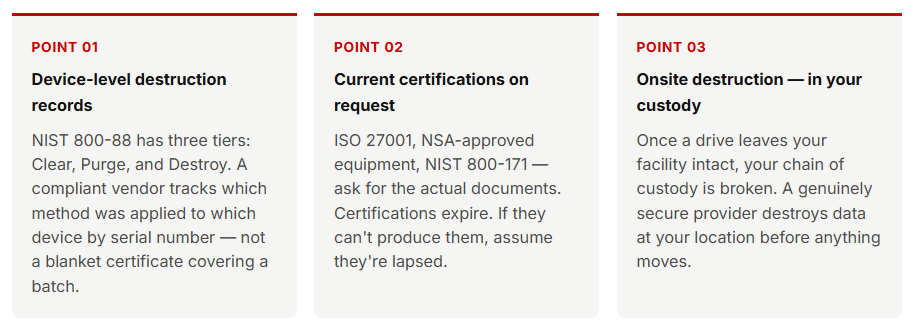
| What a Real Compliant Provider Can Show You
| The Question to Ask Before an Auditor Does
If I had to prove today that every drive from our last refresh was destroyed to the right standard, tracked by serial number, by a certified provider — could I do it?
If the answer is anything other than yes, the 2-minute risk assessment below shows you where the gaps are:
| What TechR2 Brings to the Table
TechR2's patented Track-Contain-Destroy-Verify process answers all three questions above. Every device is tracked by serial number from end-of-life identification through onsite destruction using NSA-approved equipment. Sanitizer and verifier documentation is generated for every device — tying the certificate to the specific drive it covers.
TechR2 holds six current ISO certifications, including ISO 27001, 14001, 9001, and 45001, and conducts quarterly compliance checkups to keep your program aligned as standards evolve, including the September 2025 update to NIST 800-88 Revision 2. Compliance isn't a certificate. It's a process, a chain of custody, and documentation that holds up when someone starts asking questions.